
There is a misconception within most hiring briefs that a good community manager is whoever gets the most reactions on a pinned announcement. Kill that idea now. It measures the wrong thing entirely.
A great crypto community manager is judged on the one day a fake admin DMs your holders, not the 364 days everyone was posting rocket emojis. That's not a hypothetical. Chainalysis found impersonation scams grew more than 1,400% year-over-year in 2025, which means the fake-admin scenario in this piece isn't a stretch exercise. It's a Tuesday.
If you're hiring purely on vibes and follower counts, you're vetting a host, not an operator, and your crypto community management function will fold the moment something actually goes wrong. Most crypto marketing teams reading this have already had a version of that Tuesday and just haven't named it yet. This piece gives you crypto community manager interview questions built as scenario prompts, an evidence-discipline scorecard and a paid practical exercise designed to expose judgment under pressure, not just a candidate's ability to talk about "engagement."
Define the Role Before the Interview
Start by admitting the job title is doing five jobs at once, and decide which ones you're actually hiring for. "Community manager" gets used as a catch-all for moderator, support lead, community strategist, ambassador manager and social manager, and most job posts never separate them.
A moderator polices behavior in real time: bans, mutes, spotting the fake-admin account before it DMs twelve people. A support lead answers the same three questions all day and needs to know exactly where the line sits before a query becomes "go read the docs" or "escalate to the team." A community strategist thinks in quarters, not comments: retention cohorts, event calendars, channel health.
An ambassador manager runs the volunteers and regional leads. It's a management job wearing a community-management coat, and it's worth reading up on separately if you're weighing whether to build one at all, in our guide to crypto ambassador programs. A social manager owns the public-facing feed on X, which sits closer to content and brand voice than to moderation at all.
Write the job description around one or two of these, not all five. A single hire trying to cover moderation, support and strategy at 2am during a market crash is how good people burn out and good communities go quiet. If the role genuinely spans channels, decide now whether that's one strong generalist or a small team. The interview questions differ depending on which you're building toward.
Use Scenario-based Questions
Test judgment, not vocabulary. Ask what the candidate would actually do in five specific situations, and listen for the sequence of actions, not the buzzwords a résumé taught them to reach for. Some of our best, most reliable and knowledgeable moderators aren't English native, but that's not really the aim of the game here. Buy competency, not expert-level prose.
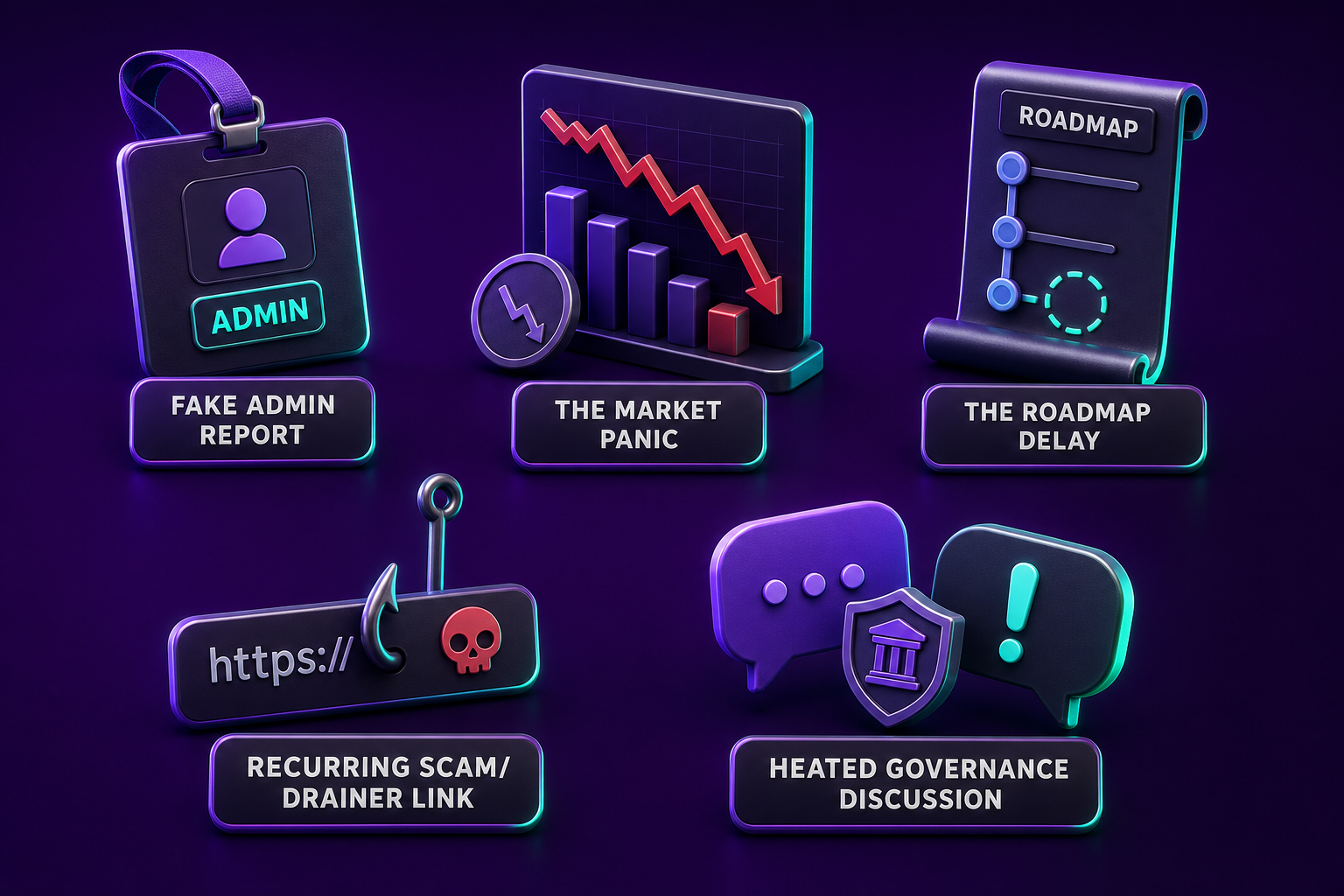
Run these five, in order, and don't accept a generic answer to any of them:
- The fake-admin report. A member DMs saying someone claiming to be a team admin asked them to "verify" their wallet in a private channel. What do the first three actions look like?
- The market panic. Price drops 40% in an hour and the general channel is a wall of "is the team rugging us." What gets posted, and what doesn't?
- The roadmap delay. A public deadline is about to be missed and the team hasn't agreed on messaging yet. How does the candidate buy time honestly?
- The recurring scam link. The same phishing link keeps reappearing from newly created accounts. What's the fix beyond deleting the message each time?
- The heated governance discussion. A proposal vote is splitting the community and two respected members are attacking each other publicly. Where does the candidate intervene, and where do they deliberately stay out of it?
None of these have a single correct script. You're listening for whether the candidate reaches for verification and de-escalation first, or for a confident-sounding answer that skips straight past both. In the real version of scenario one, scammers monitor public Telegram and Discord chats for people who sound confused, then slide into their DMs posing as support. A candidate who's never thought about that pattern will talk you a good game and still get your holders drained.
Score Evidence Discipline
This is the section most hiring processes skip entirely, and it's the one that actually predicts whether someone will make an incident worse. Score every scenario answer against four behaviors: does the candidate verify before acting, escalate when the stakes exceed their authority, document what happened, and resist the urge to speculate publicly.
A candidate who says "I'd confirm with the team's official channel before touching anything" is showing you verification instinct. One who jumps straight to "I'd tell the user it's fine" without checking anything is showing you the opposite. That instinct doesn't improve with tenure.
Escalation is the harder trait to test, because good candidates sometimes undersell it out of a desire to sound capable and self-sufficient. Ask directly: "At what point in that scenario would you have looped in the founder or the security lead, and what would you have sent them?" A strong answer names a trigger, not a vague "if it got worse."
Documentation matters just as much. A moderation log with no timestamps and no context is worthless six months later when the same account resurfaces under a new name. Here's an example of how a simple scoring sheet for one scenario might look:
| Behavior | Weak signal | Strong signal |
| Verifies | Acts on the report as stated | Checks official channel or asks a second source first |
| Escalates | Handles it alone regardless of scale | Names a clear threshold for looping in the team |
| Documents | No record kept | Timestamped note with screenshots or message links |
| Avoids speculation | Guesses publicly about cause or intent | States only confirmed facts to the community |
Assess Crypto Literacy Safely
Test whether a candidate can read the chain, not whether they can give advice about it. The useful skill here is interpreting public documentation and public data well enough to answer a member's question accurately, or knowing when to hand it off. It is never diagnosing a wallet issue or recommending a financial action.
A fair prompt: give the candidate a public block explorer link to a real, already-public transaction and ask them to explain in plain language what happened. You're not testing whether they can debug a stuck transaction live. You're testing whether they can read a confirmed transfer, recognize a contract interaction, and describe it without guessing at intent.
Ask a second question alongside it: "A member says their transaction has been pending for two hours. What do you tell them, and what do you not tell them?" The right answer routes the member toward official support or documentation and stops well short of touching their wallet, checking their seed phrase, or promising a fix. This is exactly the boundary Coinbase draws in its own consumer guidance, which states plainly that it will never ask a customer to transfer funds or make an unsolicited call asking them to move money. A community manager who can recite that boundary without prompting has just told you they're safe to trust with a live incident.
This is also where you separate community operators from people quietly overstepping into unlicensed financial advice. A candidate who says "here's roughly what's happening, and here's where to get an official answer" is doing the job correctly. One who says "just do X to your wallet" has just told you they'll do that live, in public, under a member's real financial pressure. That is a fireable offence waiting to happen, not a nice-to-have skill gap.
Test Communication Craft
Writing under pressure is a testable skill, so test it directly rather than trusting a portfolio of old announcement posts. Give the candidate three short writing prompts and score the drafts against each other, not against an abstract ideal.
Ask for a short incident update, three sentences, written as if a smart contract paused deposits an hour ago and the team is still investigating. Ask for an FAQ answer to a genuinely awkward question, such as "why hasn't the audit been published yet." Ask for a de-escalation message aimed at a member who is publicly accusing the team of a rug pull with no evidence.
Good incident-update writing states only what's confirmed, names the next update time, and never promises an outcome the team hasn't guaranteed. Good de-escalation writing acknowledges the member's frustration without agreeing with an unproven accusation, and without escalating the argument in public.
A polished draft can still fail the job. If a candidate's writing reads calm and confident but states something nobody's actually verified yet, that is the evidence-discipline failure from the scenario round showing up again on the page. Mark it down however good the sentence sounds, because confidence in writing is not the same skill as accuracy in writing.
Run a Paid Practical Exercise
Pay for a short, synthetic exercise before you make an offer, and build it so nobody's real data or real access is anywhere near it. Give the candidate a fictional project, a fictional incident and a fictional Discord export, and ask them to draft the incident update, the FAQ answer and a one-paragraph escalation note to "the founder."
Two hours is a reasonable ceiling, and paying for it is not optional. Asking an unpaid candidate to do a founder's job for free is exactly the kind of thing that gets screenshotted and shared in the communities you're trying to build trust with, and it tells good candidates precisely what kind of employer you'll be. Get written consent on what the exercise covers, and make it explicit that no real member data, no real wallets and no live moderation tools are involved at any point. If a candidate would need access to a real server to prove themselves, that's a red flag about the exercise design, not a reason to grant the access.
Score the exercise against the same criteria you used in the interview: verification instinct, escalation judgment, writing clarity, and whether they stayed inside the literacy line rather than drifting into advice-giving. A candidate who aces the live conversation but produces a sloppy written exercise has just told you something real. The live conversation isn't the deliverable during an actual 2am incident. The written record is.
Conclusion
Hire for what a candidate does with an uncertain report at 2am, not for how confidently they describe a campaign they ran somewhere else. The scenario questions, the evidence-discipline scorecard and the paid practical exercise above are built to surface that difference before it costs you a community's trust, and the cost is not abstract. Impersonation alone accounted for more than $17 billion stolen through crypto scams in 2025, and a single unchecked impersonator working one Discord server can rack up real victims before anyone official notices. A Brooklyn case involving nearly $16 million and roughly 100 victims showed exactly that.
None of this replaces a proper operating model. A scorecard tells you who to hire. It doesn't tell you where moderation authority ends and founder authority begins, what your escalation channel looks like at 3am, or how a single manager's coverage should split across Discord, Telegram and X. That's a structural decision, and it's worth making deliberately rather than inheriting it from whoever you happened to hire first.
The right hire protects community trust as well as engagement. Ask Creative Impact Group to help define a crypto community-manager scorecard and operating model through our contact page, and there's no cost to scope the conversation.
FAQs
What skills matter most in a crypto community manager?
Verification instinct and escalation judgment matter more than posting cadence or follower counts. A candidate needs to know when to check a claim before acting on it, when to loop in a founder or security lead, and how to write calmly without stating anything unconfirmed. The limitation worth naming: none of this replaces a defined operating model, so even a strong hire needs clear escalation channels and authority limits set out in advance, something our crypto community management page walks through in more detail.
Should a community manager know how to use a block explorer?
Yes, at a basic level, they should be able to read a confirmed transaction and describe it in plain language. That's different from diagnosing a wallet issue or advising a member on what to do with their funds, which is where the role should stop. Test this with a real, already-public transaction rather than a live or sensitive one, so nobody's actual holdings are ever part of the exercise.
How can an interview test scam-response judgment?
Run a fake-admin scenario and score the sequence of actions, not the vocabulary. A strong candidate verifies through an official channel first, escalates at a named threshold, and avoids telling the member anything unconfirmed. Impersonation is now the fastest-growing category of crypto scam, so this isn't a theoretical test; it reflects what's actually happening in the complaints data regulators are seeing.
What is a fair practical hiring exercise?
A paid, synthetic exercise using a fictional project, incident and Discord export, with no real member data, wallets or live moderation access involved. Two hours is a reasonable ceiling, and consent on what the exercise covers should be explicit before the candidate starts. If you're weighing whether to build this in-house or bring in outside support to design it, our case studies show how that kind of structure gets built for real projects.
Can one community manager cover Discord, Telegram, and X?
Sometimes, but it depends on scale and incident load, not on how capable one person is. A single hire covering moderation, support and public-facing content across three channels during a live incident is a workload problem, not a skills problem, and it's often the reason good people burn out within months. If coverage is spread thin, it's worth deciding deliberately whether that calls for a small team rather than one generalist, a conversation you can start on our contact page.