

Three founders can use the words "fair launch" this month and mean three different things. Only one of them will survive contact with their own community once the token is live, and it won't be the one who chose the word because it tested well.
This guide sets out what each launch model actually is, what a team running each one can honestly claim, and what happens to that claim the day after tokens go live. A lot of crypto marketing teams reading this are choosing between a fair launch, a presale, or a stealth launch right now, so treat this as the planning document you wish someone had handed you before you picked a mechanism.
Define the Models Without Marketing Spin
A fair launch, a presale, and a stealth launch differ on one axis: who gets tokens, when, and under what disclosed rules. Everything else — the marketing language, the community tone, the sense of urgency — is downstream of that mechanism, not separate from it. Pick the mechanism first and the marketing writes itself honestly. Pick the marketing first and you're building a promise your own contract can't keep.
A fair launch means no party, including the team, gets preferential access, pricing, or timing before the public. Pump.fun's bonding-curve model is the cleanest real-world example: it explicitly forbids presales, team allocations, or vesting for any token created on the platform, and gives no one early access before the curve opens to everyone at once. That structural constraint is what makes the word "fair" defensible. Say it without the constraint and you're just wearing the label as a costume.
A presale sells tokens to a defined group ahead of public trading, usually at a discount, in exchange for early capital and often marketing reach through that early cohort. It isn't automatically less fair than a fair launch — it's a different trade entirely. You give up the no-preferential-access claim, and in return you get a funding round and a defined base of holders who joined on disclosed terms.
A stealth launch skips the announcement altogether. The token exists, sometimes trades, before most of the eventual community even knows it's there. CoinGecko describes it as a fair launch with little to no pre-launch engagement, where no information is available until after the token is already live. The access is technically open to anyone watching the chain in real time. Almost nobody is, which is the whole trick and the whole risk in one sentence.
Here's how the three compare on the variables that actually matter to a marketing team:
| Variable | Fair Launch | Presale | Stealth Launch |
| Who gets tokens first | Anyone, simultaneously | Approved allowlist or KYC'd buyers | Whoever is watching the chain |
| Price disclosed in advance | Yes, via public formula | Yes, in sale terms | No |
| Pre-launch marketing window | Days to weeks | Weeks to months | None |
| Team allocation disclosed pre-launch | Usually none | Yes, in tokenomics | Usually undisclosed until after |
| Community can verify claims before buying | Yes | Yes | No |
*Three mechanisms, three different marketing jobs — the table is what decides which claims you're allowed to make.*
Map the Promise to the Mechanism
You can only claim what your mechanism structurally delivers, and no amount of copywriting talent changes that arithmetic. Say "fair" about a launch with a hidden team allocation and you haven't done marketing — you've written a confession with a nicer font.
Fairness needs the distribution mechanism to actually prevent preferential access, not merely gesture at wanting to. A bonding curve that opens to everyone at the same block height earns the claim. A "fair launch" with a pre-mined team wallet doesn't, no matter how carefully the announcement is worded around it.
Access has to match the eligibility rules actually enforced on the day, not the vibe of the landing page. A presale that says "open to all" while running invisible allowlist gating isn't describing itself — it's describing what it wishes were true. Say what the rules do, not what the label implies, and your community will forgive almost anything except that gap.
Community-first needs a real mechanism for input before the fact, not a Discord that materializes after the tokens are already out. Timing claims — "early access," "limited window" — need a published schedule a reader can check against a block explorer, not a countdown timer bolted onto a marketing page with no anchor underneath it.
None of this is about which model is virtuous. It's about whether the marketing survives the same scrutiny the tokenomics will get, because on-chain data is the one part of crypto that has never once cared about your messaging.
Fair-launch Communication Playbook
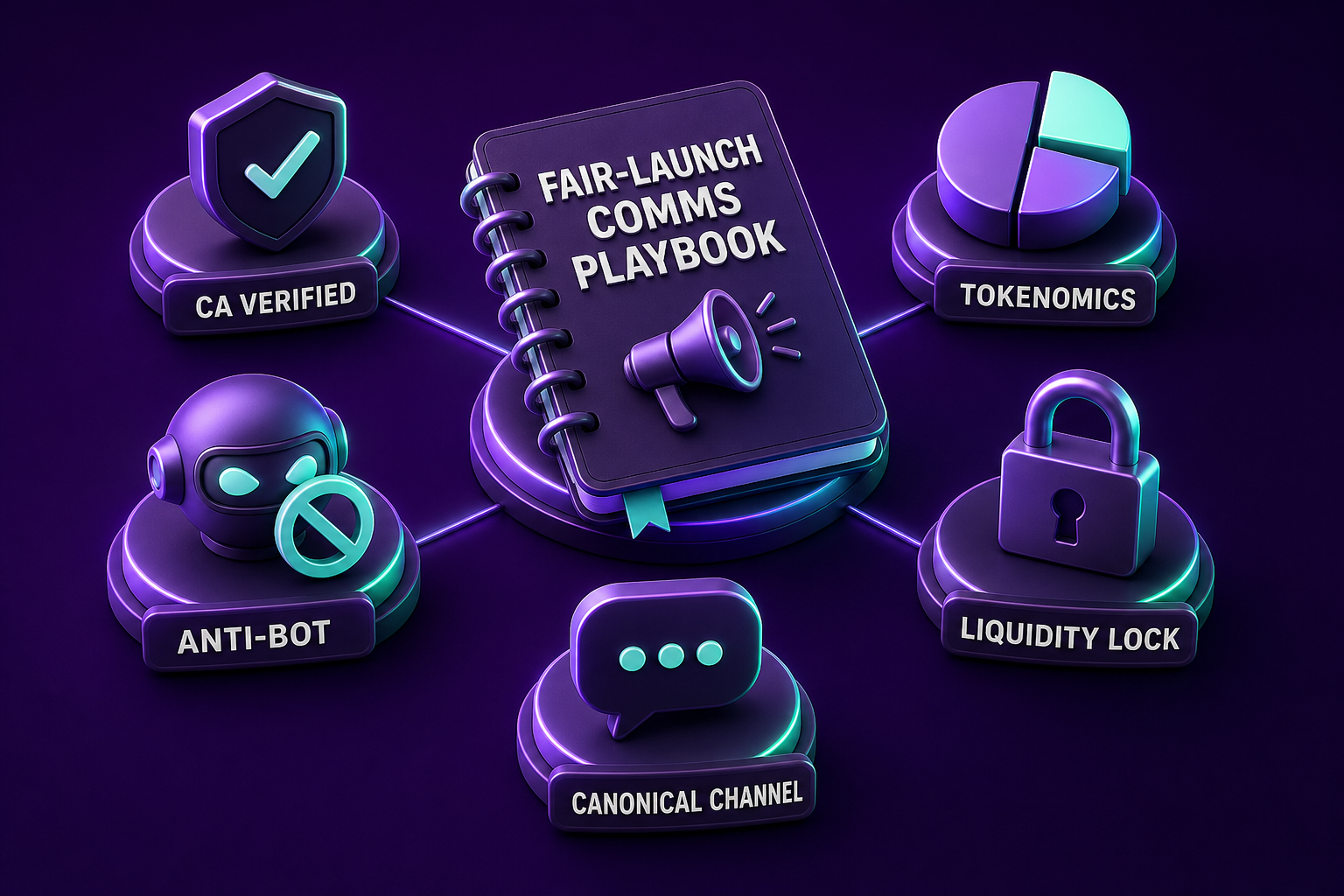
A fair launch's entire credibility rests on rules published before the mechanism runs, not explained after someone gets suspicious. If the anti-sybil policy, the launch formula, and the contract address aren't public before the block that starts trading, you don't have a fair launch. You have an unverified claim wearing a good outfit.
Publish the mechanism, not just the outcome. State exactly how tokens will be distributed: the bonding curve formula, the block or timestamp the launch triggers on, and whether any allocation exists outside the public sale.
If there's a team or treasury allocation, disclose the percentage and the lockup terms before launch, not after someone finds it sitting on-chain. Silence here reads as concealment even when it was only an oversight.
State the anti-sybil policy plainly, too. Wallet caps, cooldowns, or bot-detection measures should be named in advance, along with what happens when they trigger. A rule enforced silently, discovered later by a community member with too much free time, becomes a rule that looks hidden on purpose.
Think of this as the pre-storm checklist, the thing you nail down before the countdown starts rather than during the panic after:
- Contract address, verified and published ahead of launch
- Token distribution mechanism, written in plain terms a non-developer can follow
- Anti-sybil or anti-bot measures, named specifically
- Liquidity lock details, including duration and the locking contract
- A single canonical announcement channel, so screenshots of "official" terms from elsewhere can be dismissed fast
This is unglamorous work, closer to legal admin than to a launch trailer. It's also the only work that makes the word "fair" hold up once someone checks the chain against your announcement.
Presale Communication Playbook
A presale's credibility comes from disclosed eligibility and terms, not from the size of the discount. The mechanism trades open access for early capital, and your job is making that trade legible rather than dressing it up as something it structurally isn't.
Eligibility rules need to be public and specific: who qualifies, what KYC or wallet-verification steps apply, whether geography restricts anyone. Vague eligibility that turns out to mean "a small allowlist" is one of the fastest ways to burn trust with everyone who didn't make the cut.
Allocation and vesting terms belong in writing before the round opens, not in a defensive FAQ once buyers start asking. State the total presale allocation as a percentage of supply, the vesting schedule for both public and team tokens, and when liquidity gets locked. Numbers you publish before the doubt arrives cost you nothing; the same numbers published after cost you the whole relationship.
Risk disclosure isn't a compliance afterthought here — it's the difference between a buyer who understands what they hold and one who feels misled the moment price moves against them. This is jurisdiction- and design-dependent territory: the SEC's own framework treats classification as a facts-and-circumstances question, not a fixed label. Get qualified legal review before you finalize what your presale can say, in your specific structure and jurisdiction. This piece is the marketing discipline, not the legal one, and the two should never be confused for each other.
Build an evidence hub rather than a scattered thread history. One page holding the audit, the team's verifiable identity or a clearly stated reason for anonymity, the tokenomics breakdown, and the contract address gives your community and the press one place to check your claims, instead of stitching them together from six different channels at 1am.
Stealth-launch Communication Playbook
A stealth launch inverts the entire communications problem: there's no pre-launch window to manage, because there's no pre-launch. The job shifts overnight from building anticipation to managing what happens the second people find out you exist.
That information asymmetry is the whole model, and it cuts both ways. 1inch's own analysis notes the model is popular on Solana, Base, and Blast precisely because it removes the window where bots and snipers can prepare — but it also notes the vast majority of stealth-launched tokens either die within days or turn out to be scams. Choose this model and you're standing in a lineup where most of the other suspects are guilty.
Disclosure timing has to be decided in advance, even without a public announcement. Decide before launch, not during it, when team identity, audit status, and tokenomics become public. Have that information sitting ready to publish the moment attention arrives, rather than assembling it under pressure while your mentions blow up.
Community handover is the part most stealth launches skip entirely. If the token gains traction, a Discord or Telegram appears reactively, usually staffed by whoever noticed first — which is rarely the founding team. Plan the handover: who moderates, what gets pinned first, how the team surfaces proof of identity and audit status once it decides to go public. A stealth launch that goes well still needs a coherent public face fast, not eventually, once the crowd shows up uninvited.
Rug-pull behavior is disproportionately associated with this model, and the numbers back that up rather than just the reputation. Chainalysis-sourced data found that 3.59% of all new tokens minted in 2024 displayed classic pump-and-dump behavior, generating $2.57 billion in artificially inflated trading volume that year. A legitimate stealth launch has to work harder, not less hard, to separate itself from that base rate once the community actually turns up.
Plan the Post-launch Obligation
The marketing job doesn't end at the token generation event for any of these three models. It just changes shape, and what you owe your community after launch is set entirely by what you promised before it.
Fair-launch teams owe ongoing proof that the "no preferential access" claim held up in practice. That means publishing wallet distribution analysis if concentration questions come up, and being ready to explain any large early holders transparently rather than letting speculation fill the silence.
Presale teams owe a running account of what the raised capital funds and when locked tokens unlock. Vesting cliffs are a known flashpoint: if your schedule releases team tokens on a date your community didn't clock, the sell pressure and the trust damage arrive together, on the same day, compounding each other. Put the unlock calendar somewhere permanent and reference it before each unlock, not after someone spots the wallet movement themselves.
Stealth-launch teams owe the fastest pivot to normal operating transparency, because they started furthest from it. Once a team surfaces publicly, the audit, the contract verification, and the liquidity lock status need to appear immediately and stay pinned at the top of every channel. Delay here reads as confirmation of exactly the risk pattern the model is already associated with, deserved or not.
Across all three, feedback loops matter more than announcement cadence. A crypto community management function that surfaces real sentiment and flags emerging concerns before they snowball into a coordinated pile-on is worth more, post-launch, than another content calendar. If you're still weighing whether your current model fits your project's stage, our crypto go-to-market framework covers the decision points that come before launch-model choice, not just after it.
Conclusion
The honest version of comparing fair launch, presale, and stealth launch marketing was never about which model is more virtuous. It's about which claims survive someone checking the contract against your announcement, line by line, at a time of their choosing rather than yours.
Use this as a quick reference for where each model's marketing has to focus:
| Priority | Fair Launch | Presale | Stealth Launch |
| Primary claim to protect | No preferential access | Disclosed terms and eligibility | N/A pre-launch |
| Key document | Distribution mechanism | Evidence hub with audit and tokenomics | Rapid-disclosure identity pack |
| Biggest post-launch risk | Hidden concentration | Unlock-date sell pressure | Slow pivot to transparency |
| What marketing cannot claim | Guaranteed decentralization | "Open to everyone" | Any pre-launch promise at all |
*The one-page version: pick your priority column before you pick your press release headline.*
Your marketing claims have to match the launch mechanics you actually built, not the ones that sound best in a draft announcement. Contact Creative Impact Group to align your token-launch narrative, evidence, and community plan with whichever model you've chosen.
FAQs
Is a fair launch always fairer than a presale?
Not automatically — "fair" describes a distribution mechanism, not a moral ranking against other models. A fair launch with an undisclosed team wallet is less honest than a presale that publishes its allocation and vesting terms in full. Judge the model on what it discloses and enforces, not on which word appears in the announcement.
When does a presale make strategic sense?
A presale makes sense when a project needs early capital and a committed early holder base more than it needs a maximalist fairness claim. It suits teams building something that requires funding before launch, provided eligibility, allocation, and vesting terms are public before the round opens. Our crypto presale marketing services page covers what that evidence layer looks like in practice.
What are the risks of a stealth launch?
The core risk is that legitimate stealth launches get lumped in with the majority that don't survive or turn out to be scams. Chainalysis-sourced reporting found 3.59% of tokens minted in 2024 showed classic rug-pull behavior, and a stealth launch has no pre-launch track record to argue against that base rate. The team also carries the entire disclosure burden reactively, once attention arrives, rather than on a schedule it controls.
How does the launch model affect community management?
Launch model sets the starting trust level a community management function has to work from. Fair launches need ongoing proof that access stayed equal, presales need transparency around unlocks and fund use, and stealth launches need a fast, credible pivot to normal disclosure once the team goes public. Our crypto community management approach is built around that difference rather than a single generic playbook.
Can a project switch launch models?
A project can change its go-forward communications, but it cannot retroactively change what already happened on-chain. A team that ran a stealth launch cannot later claim it was always a fair launch, because the distribution history is public and permanent. What it can do is adopt fair-launch-style transparency from that point forward and be explicit that this is a change in disclosure practice, not a rewrite of the launch itself.