
You've drafted the pitch email three times and deleted it three times, because the first line is always some version of "our founder, who prefers not to share his name." You know how that reads to a reporter who gets forty of these a day. Most go straight in the bin, not because the project is bad, but because there's nothing in the email a human being can check — and no journalist got into this trade to take things on faith.
That's the actual problem, and it has nothing to do with whether anonymity is morally fine. It's a verification problem, and verification problems have engineering solutions, not PR-speak solutions. A lot of crypto marketing teams reading this will already sense that no amount of polish fixes a pitch with nothing underneath it. This piece walks through what a pseudonymous team can hand a journalist instead of a name: a package of evidence built from code, contracts, governance and audit scope, plus a source-access arrangement that gives a reporter real confidence without ever requiring a legal identity. If you're also weighing up crypto PR as a channel at all, this is the groundwork that decides whether it works.
Anonymity Is a Disclosure Choice, Not a Trust Substitute
Anonymity isn't a trust strategy. It's a decision about what you disclose, and it comes with real benefits and real costs that most PR advice flattens into a single, lazy question: doxxed or not doxxed.
The benefit is genuine. Pseudonymity protects founders from physical risk, regulatory overreach in hostile jurisdictions, and the kind of personal harassment that has followed more than one named crypto team. Plenty of credible projects run this way by design, not by accident, and nobody remotely serious thinks a name on a founder bio is a magic trust spell anyway.
But none of it earns trust on its own, and treating it as though it does is how teams end up all hat, no cattle. Trust gets built through evidence the audience and the press can actually check, independent of whose name sits on the page. CoinDesk's own ethics policy is instructive here. It states that the outlet will respect the pseudonymity of a source with an established reputation, treating that track record as sufficient accountability without a legal name attached.
That's not generosity. It's a working editorial standard, and it tells you exactly what to build: a reputation and an evidence trail a reporter can verify independently of your identity. Readers and investors expect something slightly different from journalists, too. A retail investor skimming a token page wants reassurance. A journalist deciding whether to run a story wants something they can stand behind if a reader calls the claim out six months later. Design your evidence package for the second audience, and the first one benefits automatically.
Map What Can Be Verified Publicly
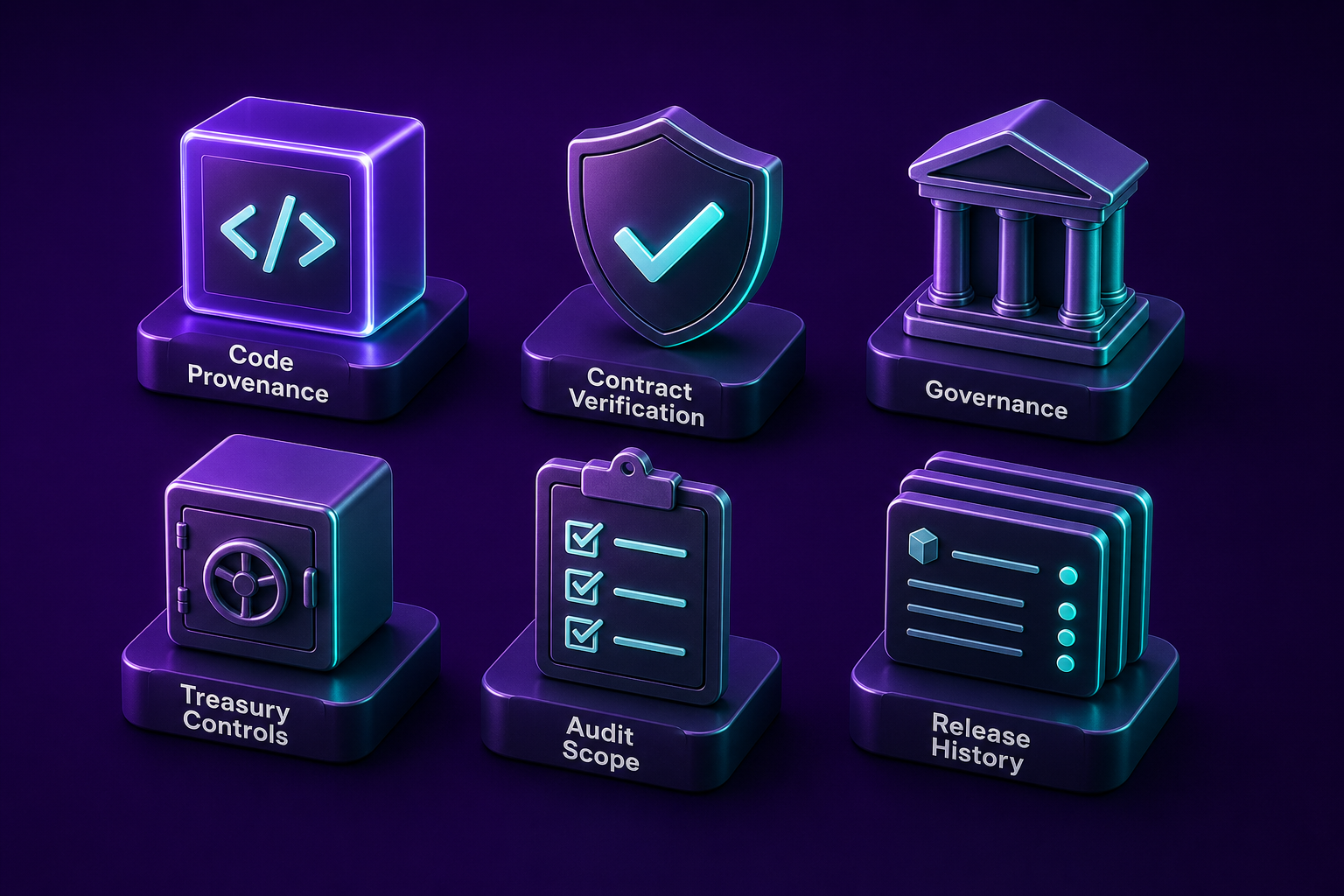
Start with what's already on-chain and in the open, because that's the evidence a journalist can check without ever speaking to you. Code provenance comes first: a public GitHub history with real commit activity, multiple contributors, and a changelog that matches what's actually deployed.
Smart contract addresses should be verified on the relevant block explorer, with source code published and matched to the deployed bytecode. Governance is next. If there's a DAO or multisig controlling treasury or upgrades, the signer addresses, the quorum threshold and the voting history are all public and all checkable in minutes.
Treasury controls matter just as much as governance design. A multisig with a sensible signer count, a visible transaction history and no single wallet holding unilateral upgrade keys tells a reporter more than any paragraph of marketing copy ever could.
Audit scope needs the same precision: which contracts were covered, which were explicitly out of scope, and whether the firm's findings were resolved or merely acknowledged in a footnote. Here's what that evidence package looks like laid out for a reporter:
| Evidence type | What to provide | What it proves |
| Code provenance | Public repo history, commit activity, changelog | Development is real and ongoing |
| Contract verification | Verified source matched to deployed bytecode | The code running is the code published |
| Governance | Signer addresses, quorum rules, vote history | Control isn't held by one anonymous wallet |
| Treasury controls | Multisig structure, transaction history | Funds aren't movable by a single party |
| Audit scope | Firm name, contracts covered, findings resolved | Security claims are bounded and checkable |
| Release history | Tagged releases matched to mainnet deployments | Claims match what's actually shipped |
None of this requires a name.
All of it requires discipline most teams don't bother with until a journalist asks. That's exactly the wrong time to start building it.
Create a Privacy-respecting Source Package
A source package is what you hand a reporter instead of a name, and it has three parts: the public evidence above, an attributable pseudonym with a track record, and a narrowly bounded private verification step where it's genuinely warranted.
The pseudonym needs history behind it. A founder alias active on governance forums, technical Discords or X for a year or more, with a consistent writing style and a visible pattern of decisions, functions as a reputational identity a journalist can research independently. That's closer to how a beat reporter treats a long-standing confidential source than how most crypto teams imagine it.
Fortune's reporting on LooksRare's pseudonymous co-founders Guts and Zodd is a useful case study here: the pair built investor and media relationships entirely through their on-chain and community track record, with no legal names ever disclosed.
Private verification is the narrow exception, not the default. If a reporter genuinely needs more confidence — say, proof that the same person has controlled a wallet across a project's entire history — the right structure is a one-time cryptographic signature check or a brief video call with identity concealed, scoped to answer exactly one question. That distinction between verified by the reporter and disclosed to the reader is the whole mechanism, and most PR guidance skips it entirely because it assumes disclosure is binary.
Don't ask a journalist to sign an NDA to access basic project facts. Reputable outlets generally won't agree to one for routine reporting, and asking signals you have something to hide rather than something to protect.
Be Candid About Limitations
Anonymity has a cost, and pretending otherwise is the fastest way to lose credibility with the person who actually decides whether the story runs. Say the quiet part first, because a reporter will find it anyway.
Fortune's reporting on the LooksRare founders documents the practical cost directly: the team struggled to hire, because candidates were wary of joining a company with no accountable leadership they could verify. Anonymity doesn't just affect press relations. It shapes hiring, partnership negotiations and investor conversations in ways a founder should plan for rather than discover halfway through a funding round.
It also doesn't make you immune to exposure. A journalist used nothing but public records to identify the pseudonymous founders behind Bored Ape Yacht Club. Wonderland DeFi's treasury lead, known publicly only as 0xSifu, was revealed to be a co-founder of the collapsed QuadrigaCX exchange, and the fallout from that single revelation did more damage to the project than any critical article would have managed on its own. Both cases are documented in Cointelegraph's reporting on how anonymous culture has struggled under sustained scrutiny.
The lesson isn't "doxx yourself." It's that your privacy boundary needs to be a decision you've stress-tested, not a hope that nobody looks hard enough. Most ranking advice on this topic, including investor-facing explainers that list audits, KYC and doxxing as interchangeable trust signals, never gets to this point. They treat the choice as settled once you've picked a side.
Choose Stories That Fit the Evidence
Pitch stories your evidence package can actually carry. A personality profile is the worst possible fit for a pseudonymous team, because the entire format depends on the one thing you've chosen not to supply.
A technical milestone, a governance decision, a security disclosure or a data-backed usage trend doesn't need a face attached to be newsworthy. These stories need the numbers to hold up, and a pseudonymous team can supply numbers as credibly as a named one. If your protocol just crossed a meaningful TVL threshold, if your DAO just resolved a contentious governance vote, or if your audit firm just published a clean report after a prior finding was fixed, that's a story a reporter can verify entirely through the evidence package above.
Avoid pitches that ask a journalist to take your word for a claim about intent, culture or future plans. Those require trust in a person, and you've already decided not to offer one. Pitch what the data can prove instead. For a broader sense of how this fits against other channels, our piece on crypto earned vs. paid media covers why earned coverage carries weight paid placement can't buy.
Set Crisis and Disclosure Protocols
Decide who communicates and how facts get confirmed before you need the answer under pressure, not during the incident. A crisis is the worst possible moment to improvise a disclosure policy.
Name a single communications wallet or verified channel account as the only authoritative source for official statements, and say so publicly well in advance. During an incident, state what's confirmed, what's still being verified, and when the next update will land, even if that update is only "nothing new to report." Silence reads as concealment regardless of the real reason behind it.
Keep a visible, append-only log of actions taken, such as a pausable contract being paused or a multisig transaction being executed, so the facts are checkable independently of anything your team says in a statement.
This is where the groundwork from the verification package pays for itself: a project that's already published its governance structure and signer history has a far easier time proving what happened than one explaining its controls for the first time mid-crisis.
Conclusion
Build the evidence first, and pitch second. A pseudonymous team with a verified code history, transparent governance and a clean audit trail has more to offer a journalist than a named founder with none of those things, and that ordering rarely gets said out loud in PR advice aimed at Web3 teams.
Fix this before anything else: get your contracts verified on-chain, your governance and signer history public, and your audit scope documented precisely. Leave the personality angle alone entirely; it's not a story your evidence can carry, and trying to force it will cost you more credibility than the anonymity ever did.
Pseudonymity requires stronger project evidence, not louder promises. Ask Creative Impact Group to help build a privacy-respecting media evidence package, working through exactly this checklist from the evidence layer up.
FAQs
Can a pseudonymous founder get earned coverage?
Yes, but only if the pitch carries verifiable evidence instead of a biography. A reporter can run a story built on checkable code, governance and audit data without ever learning a legal name, provided that evidence is genuinely independent and not just asserted. What they won't run is a faceless pitch with nothing underneath it — that joins the stack of projects nobody dares cover. Our case studies show what that evidence-first approach looks like in practice.
Should a journalist be asked to sign an NDA?
No, not for routine reporting on basic project facts. Reputable outlets rarely agree to NDAs before covering a story, and asking signals concealment rather than protection. Where something genuinely sensitive needs confirming, a narrowly scoped private verification step works far better than a blanket NDA request.
What public evidence matters most?
Verified contracts, public governance and signer history, and an audit with clearly stated scope, in that order. Code provenance and release history back these up, but a reporter checks the contract and the signers first because those are the facts that can't be spun. None of it requires a name attached.
Can an audit replace team accountability?
No. An audit proves the code was reviewed at a point in time; it says nothing about who controls upgrades, treasury or future decisions. Accountability still needs governance transparency and signer history sitting alongside the audit, not instead of it — what you can't substitute is the evidence itself, and no outlet will run a story built on trust in an alias with nothing checkable behind it.
What should an anonymous team disclose during a crisis?
Name one authoritative channel in advance, then state what's confirmed, what's still being checked, and when the next update lands, even if that update is "nothing new yet." Keep an append-only log of on-chain actions so the facts stand independently of any statement. Teams that published their governance and signer structure before the crisis find this far easier than teams explaining their controls for the first time under pressure. Contact Creative Impact Group to review your crisis management strategy before the eventuality of ever needing it.